
Market Overview
2026 began with expectations for lower interest rates, low energy costs, strong company profits, and steady economic momentum. Nine months later, the picture looks very different. Interest rates have risen among many central banks, energy prices have surged, and with the extraordinary company profits being reported, investors are asking: is this as good as it gets?
While the answer for what’s ahead may be more complicated in practice, the prior few months have served as a reminder of what it means to be antifragile: protecting yourself during periods of volatility while staying positioned to benefit from negative events, knowing there will be an opportunity to create value. We feel this is an important differentiator for successful long-term investors in a future which rarely feels predictable and allows us to acknowledge the exceptional gains of the prior months without becoming complacent.
In this review we share our perspective on the major events which drove the third quarter and the opportunities for the months ahead.
- Persistent inflation, unchecked government spending, and still strong economic data have contributed to a sustained rise in global bond yields and changing expectations for interest rates.
- Arguably the defining story of the quarter, the return investors are demanding on long-term government bonds reached multi-decade highs carrying implications for borrowers and investors.
- Several central banks, including the U.S. Federal Reserve, raised interest rates for the first time since 2023. Notably, this did not include the Bank of Canada which opted to hold rates given greater economic uncertainty.
- Boosted by Artificial Intelligence (AI) spending, exceptional company earnings have offered investors insulation from the broader events of 2026.
- Some slowdown in earnings growth is likely, but slower growth has not historically meant negative returns.
- AI momentum slowed as more companies pushed for greater regulation leading to concerns over when investors will see the promised returns.
- At the same time, more industries and companies are participating in the gains with growth of this magnitude rarely seen unless coming out of a recession.
- Recent U.S. led efforts to build a self-regulation system may reduce some of the concerns….or not.
- Canada-U.S. trade talks broke down in August, bringing new tariffs on both sides of the border.
- A deal is still likely but has contributed to greater uncertainty for Canada in the near-term as the Federal government works to diversify trade.
- Escalation in the Middle East led to surging oil prices. Without a clear resolution, investors will have to adapt to rising geopolitical uncertainty.
Market Returns

What Drove Markets in Q3
At first glance, the prior three months were okay for stock markets without seeing the great returns from earlier in the year. Markets largely continued their momentum into July before diverging in August and September with most sectors negative, and investors instead buying up the large technology stocks supported by the AI boom. This was an important departure from the first half of the year where investors enjoyed good returns more broadly.
What changed over the summer?
- Bond markets saw one of the worst sell-offs in decades, driving up income yields on bonds and carrying implications for borrowers and investors.
- Investors are having to contend with surging energy prices and a Middle East conflict with no clear resolution on the horizon.
Why Bond Yields Matter
At a time when central banks are increasing short-term interest rates higher, investors are exercising their influence on long-term bonds and pushing income yields towards multi-decade highs.

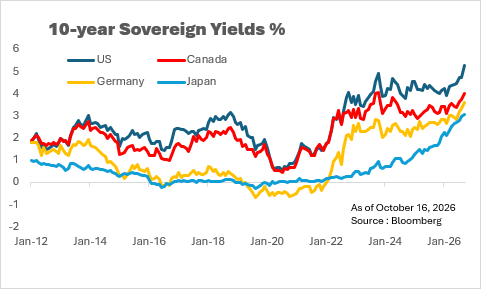
Bonds have lagged throughout 2026 but the rise in bond yields was initially gradual with investors considering the effects of the Middle East conflict and associated oil supply disruption, as well as AI spending. Several forces accelerated the summer bond sell-off (and thus the increase in available bond yields):
- Central banks have increased interest rates with expectations for more to come.
- Bond prices and interest rates have an inverse relationship (Interest rates ↑ / Bond prices ↓).
- Stubbornly high inflation with concerns for surging energy prices filtering through the economy.
- Unchecked government spending is driving investors to demand greater returns from government bonds.
- Economic growth has been far better than expected in Canada and is accelerating in the U.S.

We do not often speak about bond yields, but recent months have appeared to be more than a temporary tantrum and warrants attention as rising bond yields have an impact on just about every other investable market.
- Higher bond yields can contribute to more volatility for stocks.
- Higher long-term rates can weigh on stock valuations. They increase the rate used to discount a company’s future profits and raise costs for businesses and consumers through the higher cost of borrowing. The surge in yields is also squeezing the premium investors earn for owning stocks rather than bonds.
- This shrinking ‘premium’ for investing in stocks (the expected return above what’s available in bonds) raises the likelihood that investors will move towards bonds at the expense of stocks.
- Higher long-term rates can weigh on stock valuations. They increase the rate used to discount a company’s future profits and raise costs for businesses and consumers through the higher cost of borrowing. The surge in yields is also squeezing the premium investors earn for owning stocks rather than bonds.
So far, stocks have taken the rise in yields in stride, largely because they are being driven in part by the good news of stronger economic growth. Higher yields are affecting the most interest-sensitive parts of the economy, which is a key reason why companies outside of direct AI-related stocks have shown weakness in recent months. While we are still seeing resilience, higher bond yields and interest rates will test those limits. If yields go too far, the negatives could overwhelm the good news. There is likely a line in the sand, and so far, we have not crossed it.
The question we need to ask is: what can we do about it all?
While interest rates and bond yields pose challenges, the problem we face is not a problem with the stock market or the companies themselves. We have seen their ability to adapt to the significant events of just this decade and the fact that we have seen stronger than expected company earnings and improved economic growth provides markets some flexibility to navigate higher rates – much more than we saw in 2022 coming out of COVID.
Record Earnings
However you cut it, company earnings have been exceptional. Year-over-year earnings growth for Canada and the U.S. reached 35% and 53%, respectively. What makes this especially unusual is that growth of this magnitude typically appears only as an economy exits a recession.
This kind of growth buys the market a great deal of resilience, and it has been a major reason stocks have absorbed higher yields, higher oil prices and heightened geopolitical uncertainty. Third-quarter reports begin in a few weeks, and steady trends suggest it will likely be another good season.
Is this as good as it gets?
We believe some slowdown in earnings growth over the next year is more likely than not, partly because growth is already near peak levels. Yet slower growth, with profits still rising but at a slower pace, has historically not been a problem for market returns. If history is a guide, stock gains in the six to nine months that follow peak earnings tend to be lower, but not necessarily negative.
The difference may show up in volatility and greater dispersion between winners and losers. Events that investors have largely shrugged off over the past year may begin to carry more weight. In other words, returns may come with a bumpier ride, and we may already be in the early innings of this.
The Canada-U.S. Trade Relationship
In a story that has been building for more than a year, the breakdown of trade negotiations between the U.S. and Canada marked a significant escalation.
- Despite the headlines and uncertain environment for trade, experts estimate the new tariffs on Canada will affect just 5% of exports to the U.S. with 90% of goods remaining duty-free thanks to CUSMA.
- Persistent trade imbalances will remain a source of friction that is unlikely to go away for the foreseeable future, prolonging uncertainty and putting greater pressure on the Canadian government to incentivize business investment.
- While trade negotiations will continue to be a stress point for investors and businesses, it is part of a larger trend towards broadening Canada’s trade relationships.
Investors will be paying close attention to developments moving forward and the risk to Canadian businesses, but the prior year has proven markets’ tendency to overreact to headlines. Given that we expect this to continue, it may provide opportunities in individual names and sectors until a deal is reached.
What we are doing and why
Stocks
The prior three months moved away from the incredible run seen for stocks and towards the more narrowly defined winners benefiting from the AI investment boom. Despite the recent volatility, earnings have shown incredible strength and all eyes will be on third quarter reporting for an indication of where stocks are headed towards the end of the year and may be the deciding factor in how stocks weather the storm of rising bond yields and uncertainty surrounding the Middle East and U.S. midterm election.
We continue to place an emphasis on those with rising dividends and reasonable valuations but key to our portfolios has been seeking companies with different sources of failure unrelated to AI. While the conversation around diversification tends to focus on the number of stocks you own, far more important is how many independent sources of return those holdings represent.

Market breadth (a measurement for how many companies are participating in the gains) has narrowed in recent months at the expense of more interest-rate sensitive sectors. In September alone, almost all sectors in Canada and the U.S. were negative. This drawdown has helped improve valuations to more attractive levels and provided the opportunity to utilize our increased cash levels but impacted portfolios like ours with less reliance on the large AI beneficiaries. This challenged returns during the third quarter but represents significant diversification outside of the major AI theme driving headline returns and allows for greater flexibility as we navigate the final months of the year with an eye on 2027.
For an update on our current positioning, you can learn more about our strategies here:
Bonds
The third quarter saw one of the most severe bond market sell-offs in decades and led to rising bond yields adding an additional layer of complexity for investors. Attitudes towards bonds are about as poor as they have been and keeps coming up as a recurring theme. That one-sided positioning is usually worth paying attention to and adds to our confidence that an opportunity may be developing. This does not indicate a large shift to investment portfolios but does mean bonds are becoming harder to ignore.
- The Canadian and U.S. aggregate indices each fell about 2% in September, and the U.S. 10-year briefly pushed up to roughly 5.3% and the Canada 10-year to 4%.
- Our view is that a better entry point for adding bonds may show up in the coming months once investors have had time to react to higher yields and a softer growth outlook for 2027. Continued strength in the economy and stock earnings may also help prove the market’s flexibility for higher interest rates and bond yields.
- A 6% yield on U.S. 30-year bonds may be approaching quickly and likely to arrive before the end of the year. This is the level which may challenge stock markets in the near-term, but as we saw in 2023, the push and pull towards and away from stocks can be sizeable and brief as valuations reset lower and offer more attractive entry points.
- The market expects additional increases in interest rates. This is a significant departure from how the year began when investors had predicted declining rates.
We continue to focus our bond portfolio on corporate investment-grade bonds with shorter terms to maturity. As markets absorb higher bond yields and interest rates dictated by central banks move higher, we will look to selectively add to longer-term bonds.
Preferred Shares
There was little change over the quarter with the market for preferred shares continuing to show resilience and benefiting investors through the shrinking universe and increased income yields. Notably, the relative performance for preferred shares has been much stronger during negative days for stocks than in years past.
Commodities
Volatility in commodities and commodity-related investments continued into the third quarter but turned positive with 80% of the Bloomberg Commodity Spot Index trending higher.
- The price of oil topped $100 per barrel. High oil prices have offered support for Canada’s TSX but have contributed to rising inflation globally.
- Despite strong returns, energy remains a relatively small part of broader stock markets. Growing geopolitical risk, energy security and increasing power requirements may be what supports this sector for years to come.
- Prior gains in gold were challenged by a variety of factors not unlike what has already been discussed in this commentary: rising bond yields, U.S. dollar strength, and the simple fact that the metal was up significantly.
- Commodities trade on supply and demand, and for gold, the main character of the demand story has been central banks. That demand slowed last year, and some cracks formed with the outbreak of war forcing some smaller central banks to sell their reserves. In more recent months that story shifted with inflows in gold once again ticking higher.

The events of 2026 matter for real assets such as commodities. Global competition for critical resources restricts trade between nations and investors are expecting sustained support for prices into the future, both of which contribute to a positive view for commodities in investment portfolios.
Alternatives
The traditional 60-40 (60% stocks, 40% bonds) framework relies on bonds and equities moving in opposite directions. In recent years, that relationship has become less reliable and encouraged the use of alternative investments for greater diversification and income.
Examples of alternative investments we use in portfolios include:
- Private equity; particularly in global infrastructure assets.
- Private lending to Canadian and U.S. businesses
- Music royalties
- Litigation financing
- Inclusive of law firm lending, injury settlement lending, and estate lending.
- Private real estate
- Inclusive of Canadian and U.S. apartment buildings, student housing, self-storage facilities, and new developments.
Available liquidity continues to be a focal point for alternative investments, but most are performing in line with the industry with managers capitalizing on broader trends expected to provide differentiated income and returns outside of stocks and bonds.
TriDelta Update
We are pleased to announce that our offices have moved! We look forward to hosting you at our new locations in the months ahead.

Toronto: 4120 Yonge Street, Suite 308
Burlington: 5420 North Service Road, Suite 201
Moving Forward
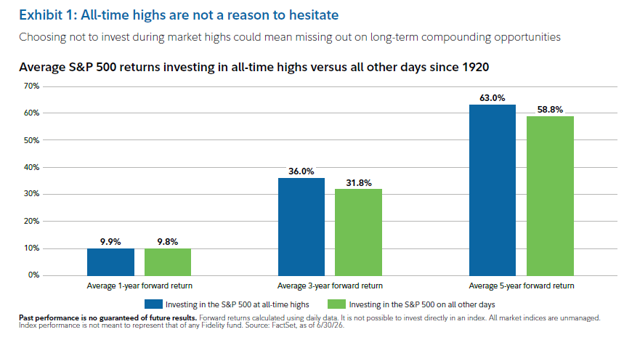
To many investors, stock markets at or near their all-time highs may feel like warning signs – a signal that gains are spent and a pullback is due. It has undoubtedly been an exceptional time for investors, but record highs alone are not a reason to step aside, particularly when company earnings remain supportive and one of the strongest arguments for the market’s resilience in the face of increased uncertainty. In fact, as the chart below demonstrates, stepping aside has historically been the wrong decision for long-term investors.
The remainder of the year and into 2027 will likely carry more volatility, not less. Whether due to policy uncertainty from governments and central bankers, persistent inflation, cooling AI enthusiasm, or the U.S. midterm election, the months ahead will rely on good judgement under uncertainty rather than running from that uncertainty. While it may all sound daunting, let’s not forget that portfolios are up a decent amount this year and have had a very good few years. We do not shy away from market volatility; we welcome it to add longer-term value and capitalize on the reactive decisions of others.